

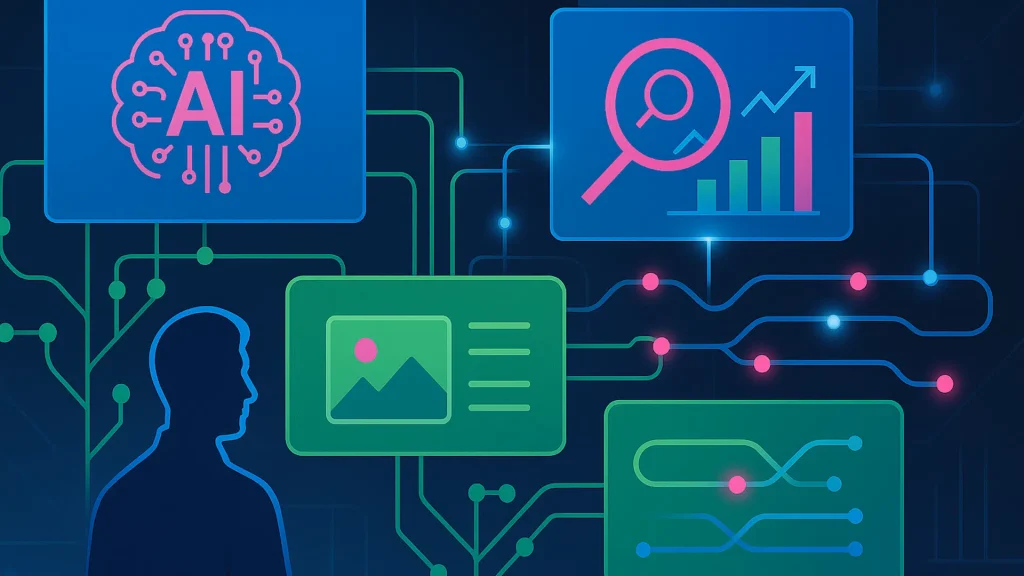
AI search PPC campaigns are rapidly transforming the way people search online. Traditional search engines once presented users with a list of links and ads, but the emergence of AI-powered search results has fundamentally changed that experience. Instead of simply delivering links, modern search engines increasingly generate direct answers using large language models and aggregated web content.
For marketers who rely on pay-per-click advertising, this shift raises important questions. If users receive answers without leaving the search page, will they still click ads? How should PPC campaigns evolve in a world where AI interprets user intent and generates responses before users even see search results?
Understanding how AI search works and how it affects paid search strategies is essential for maintaining visibility and driving conversions in the years ahead.
The Rise of AI Search
AI-powered search features are now integrated into many search engines. Platforms such as Google have introduced generative results that summarize information directly on the search results page, often appearing above traditional listings and ads. These summaries combine information from multiple sources to answer user questions in a conversational format.
This new format fundamentally alters the traditional search experience. Instead of scrolling through results, users can often find what they need directly within the AI-generated response. In many cases, these responses occupy the most prominent space on the page, pushing both organic listings and paid advertisements further down.
The impact on user behavior has been significant. Studies show that more than half of all searches now end without a website visit because users obtain the information they need directly from the search results page.
For businesses investing in PPC campaigns, this means the competition for attention has shifted dramatically.
Declining Click-Through Rates
One of the most immediate effects of AI search has been a decline in click-through rates for both organic listings and paid advertisements. When users receive answers directly on the search page, they often have little reason to click through to a website.
Data shows that when AI-generated summaries appear, click-through rates can drop dramatically. In some cases, CTR declines from about 21 percent to under 10 percent when an AI summary is present.
The reason is simple. AI search is designed to satisfy user intent immediately. If a search engine provides a detailed answer to a question, the user may not need to explore additional results or advertisements.
This shift forces PPC marketers to reconsider how they measure success. Campaigns that once relied heavily on traffic volume must now prioritize higher-quality clicks and stronger conversion rates.
Fewer Traditional Ad Placements
AI search also changes the layout of the search engine results page. Because AI-generated summaries occupy a large portion of the screen, the number of visible ad placements may decrease.
Research indicates that these summaries can take up nearly half of the visible screen space on both desktop and mobile devices.
When fewer ads appear above the fold, advertisers face increased competition for those limited placements. As a result, the auction dynamics that determine ad ranking become more competitive.
This often leads to rising cost-per-click rates as businesses bid more aggressively to maintain visibility in the shrinking premium ad space.
Rising Costs and Competitive Pressure
As ad space becomes more limited, the competition for top placements intensifies. With fewer opportunities to capture user attention, advertisers may need to increase bids to remain competitive.
Industry data already suggests that average cost-per-click rates have increased across multiple sectors in response to the changing search landscape.
At the same time, advertisers must ensure that higher ad spending translates into measurable returns. This requires more sophisticated targeting strategies, stronger landing page experiences, and deeper analysis of user intent.
In other words, AI search does not eliminate PPC advertising, but it does raise the stakes for campaign performance.
The Shift Toward Conversational Queries
Another major change brought by AI search is the evolution of search queries themselves. Users are increasingly typing or speaking full questions instead of short keyword phrases.
For example, instead of searching for “running shoes,” a user might ask, “What are the best running shoes for beginners with knee pain?”
This conversational search behavior creates new challenges for traditional keyword targeting. Ads built around simple keywords may no longer match the complex queries users now submit.
AI-powered search engines interpret these longer queries more effectively, meaning that advertisers must adapt their keyword strategies to match natural language patterns and broader user intent.
PPC campaigns that rely solely on exact-match keywords may struggle in this environment. Instead, marketers must focus on semantic targeting and intent-based keyword strategies.
Looking for a Results-Driven Marketing Agency?
AI Is Also Powering PPC Platforms
While AI search introduces new challenges, it is also enhancing the tools advertisers use to manage campaigns.
Many PPC platforms now incorporate artificial intelligence into campaign optimization. Features such as automated bidding, predictive analytics, and machine learning-driven targeting allow advertisers to improve performance with less manual management.
In fact, most advertisers already rely on AI-driven tools. Research shows that about 85 percent of advertisers now use automated bidding strategies, while more than half of Google Ads accounts use AI-powered campaign formats such as Performance Max.
Additionally, marketers increasingly use generative AI tools to assist with ad copy creation and testing. Surveys indicate that approximately 75 percent of PPC professionals use generative AI to help write advertising content.
These tools enable marketers to respond more quickly to changing search behaviors and optimize campaigns based on real-time data.
New Metrics for a New Search Landscape
As AI search reshapes how users interact with search engines, traditional performance metrics may become less meaningful.
For years, PPC success was measured primarily by impressions, clicks, and cost per click. However, as more searches become “zero-click” experiences, marketers must adopt new metrics to evaluate campaign performance.
Some emerging metrics include:
Impression-to-answer rate, which measures how often a brand appears within AI-generated responses.
Assisted conversions, which track conversions influenced by ads even if the user does not click immediately.
Visibility metrics that measure brand exposure within the search environment rather than direct traffic.
By expanding measurement frameworks, marketers can better understand how PPC contributes to the broader customer journey.
Integrating PPC With Broader Search Strategies
In an AI-driven search ecosystem, PPC campaigns cannot operate in isolation. Paid advertising must align closely with broader digital marketing strategies, including content marketing and search engine optimization.
AI search engines rely heavily on authoritative sources when generating summaries and recommendations. As a result, brands that produce credible, well-structured content are more likely to appear in AI-generated answers.
This means PPC campaigns may benefit from strong content marketing efforts that reinforce brand authority and expertise.
For example, a user might first encounter a brand within an AI-generated answer, then later click on a PPC ad when they are ready to make a purchase. This multi-touch journey highlights the importance of integrating paid and organic strategies.
Opportunities for Advertisers
Despite the challenges introduced by AI search, there are also significant opportunities for advertisers willing to adapt.
First, AI-driven targeting can improve the precision of advertising campaigns. By analyzing user behavior and intent signals, machine learning systems can deliver ads to audiences who are more likely to convert.
Second, the shift toward conversational search opens new possibilities for long-tail keyword targeting. Advertisers can create campaigns that align with the detailed questions users ask when researching products or services.
Third, as organic results become more crowded by AI-generated content, PPC may become an even more important tool for maintaining visibility.
Some industry analysts even suggest that AI search may ultimately favor advertisers, since paid ads remain one of the most reliable ways to appear prominently in search results.
In other words, while AI search disrupts traditional strategies, it does not eliminate the value of PPC advertising.
Preparing PPC Campaigns for the Future
Businesses that want to succeed in the era of AI search should begin adapting their PPC strategies now.
First, marketers should focus on high-intent keywords that indicate strong purchase intent rather than informational queries that AI summaries may satisfy directly.
Second, advertisers should invest in high-quality landing pages and conversion optimization. With fewer clicks available, each visitor must have a higher likelihood of converting.
Third, companies should leverage AI-powered advertising tools for bidding, targeting, and creative optimization.
Finally, PPC strategies should align with broader digital marketing efforts, including SEO, content marketing, and brand-building initiatives.
By adopting a holistic approach, businesses can ensure that paid search remains a powerful driver of growth.
Keep Showing Up on Search Engines
Artificial intelligence is transforming search engines and redefining how users discover information online. AI-generated summaries, conversational queries, and zero-click searches are changing the dynamics of search engine results pages.
For PPC advertisers, these changes present both challenges and opportunities. While click-through rates may decline and competition for ad space may increase, new AI-powered tools and targeting strategies can help advertisers adapt.
The key to success lies in evolving alongside the technology. Businesses that understand how AI search works and adjust their PPC campaigns accordingly will be better positioned to maintain visibility, capture high-intent traffic, and generate meaningful conversions.
As the search landscape continues to evolve, PPC advertising will remain a critical component of digital marketing. However, success will depend on strategic thinking, advanced analytics, and a willingness to embrace the new possibilities created by AI.If your business wants to stay ahead of the changing search landscape, expert guidance can make all the difference. Schedule a free consultation with New Light Digital to learn how your PPC campaigns can thrive in the age of AI search.
Further reading:


